OT Cybersecurity Against Aurora Attacks
Protecting the Grid: How Process-Oriented OT Cybersecurity Defends Against Aurora Attacks
What do we know about Aurora attacks?
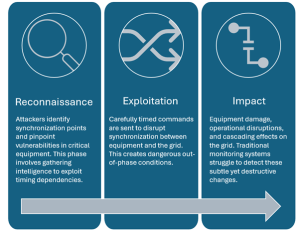
Aurora attacks exploit vulnerabilities in the synchronization of critical infrastructure, such as generators and transformers, with the power grid. These attacks cause dangerous out-of-phase conditions, leading to mechanical stress and potentially catastrophic failures in essential equipment. What makes Aurora attacks particularly challenging is that they can evade traditional monitoring systems like SCADA, which are designed to detect more obvious threats but miss subtle timing deviations.
Why Process Oriented OT Cybersecurity?
Process-Oriented OT Cybersecurity offers a solution by focusing on monitoring the physical processes within critical infrastructure. Instead of just relying on traditional network-based defenses, this approach tracks real-time data at the physical level (e.g., phase angle shifts and breaker timing) to detect anomalies that might otherwise go unnoticed. By closely monitoring the synchronization of equipment with the grid, it becomes possible to identify early signs of an Aurora attack before it causes significant damage.
Traditional cybersecurity tools are good at identifying network-based threats, but they often fail to address physical vulnerabilities that Aurora attacks exploit. These attacks target precise timing and synchronization in ways that conventional Intrusion Detection Systems (IDS) can’t detect. By integrating both network-level and process-level monitoring, Process-Oriented OT Cybersecurity offers a more comprehensive defense against these sophisticated threats.
With real-time, high-frequency monitoring and advanced detection techniques like machine learning, this approach provides operators with the insights they need to respond quickly. It allows for quicker identification of synchronization issues and a faster response, which is critical for minimizing damage and ensuring the stability of the power grid. Additionally, this method helps with recovery by offering visibility into the affected processes and guiding operators through the restoration of normal operations.
In today’s evolving threat landscape, adopting a Process-Oriented OT Cybersecurity approach is essential to safeguard critical infrastructure. By focusing on both the physical and network layers, this strategy enhances the detection, response, and recovery processes, ensuring that the grid remains resilient against increasingly sophisticated attacks like Aurora.