Bridging the Recovery Gap: Why OT Cyber Incidents Paralyze Operations for Months
test test
For a CISO, the most paralyzing aspect of an OT incident isn’t just the technical restoration – it is the high-stakes dilemma of when to trigger the recovery path.
While a confirmed cyber event requires an immediate and clear response, the reality for most operators is a grey zone, a state of unconfirmed suspicion where anomalous behavior is detected but its origin is unknown.
According to the 2025 SANS Survey (State of ICS/OT Security), 20% of organizations hit by a cyberattack require over a month to recover.
This delay occurs because, unlike IT (where system re-imaging and backup restoration are routine) OT recovery is governed by the rigid requirements of functional integrity and physical safety.
When a CISO faces suspicion rather than certainty, they must ask: Is a recovery path even feasible? Can we afford to trigger this process multiple times without total certainty?
The Friction of Remediation
A major challenge in OT recovery is the inherent conflict between rapid incident isolation and operational safety. Unlike IT where quarantines are (relatively) easy for compromised systems, an immediate shutdown of industrial control systems is rarely feasible. Abrupt interruptions to a live process can trigger catastrophic equipment failure, environmental releases, or hazardous physical conditions.
The result: full process remediation is often delayed. And a major bottleneck is the total loss of ground truth across the control layer.
Why Recovery Stalls: The Trust Deficit
When an OT breach occurs, engineers are forced into a state of operational blindness. The recovery timeline extends because:
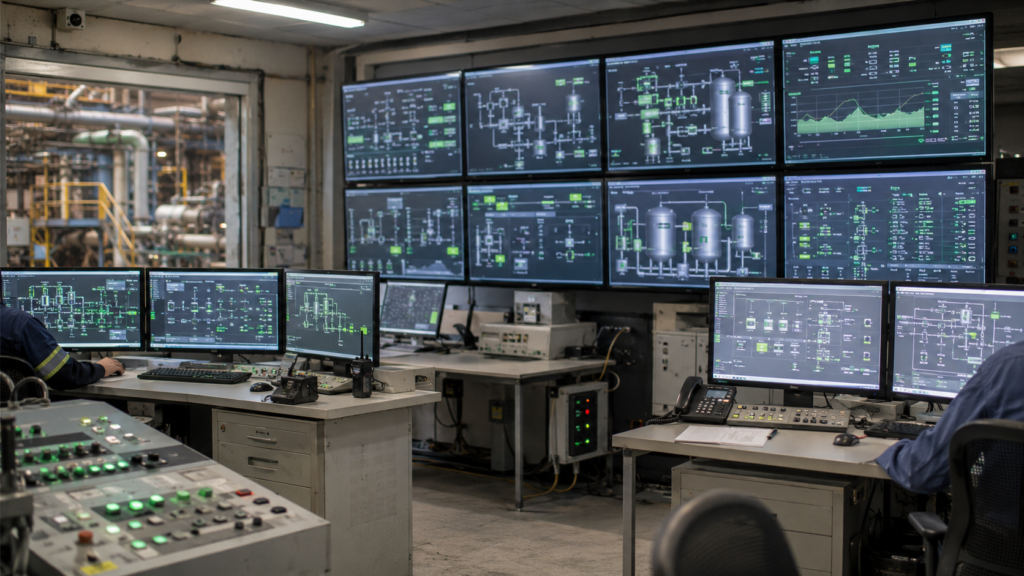
Compromised Visualization: Once the control network is breached and the control systems are potentially compromised, Human-Machine Interfaces (HMIs) and workstations can no longer be trusted as authoritative sources of information.
Logic Uncertainty: If the integrity of PLC (Programmable Logic Controller) logic or alarm thresholds is in question, a safe restart requires a line-by-line forensic audit of the code to ensure no subtle parameters were altered.
Physical Safety Risks: Until the physical reality of the industrial asset can be reconciled with the digital control layer, resuming operations is a risk to personnel and infrastructure.
The Recovery Paradox: Navigating Two Operational Realities
The technical capacity for recovery stays on the shelf if a CISO lacks the situational awareness to justify its use. In the field, the decision to initiate a recovery path is dictated by one of two distinct scenarios:
Scenario 1: The Confirmed Breach. When a cyber event is verified, the mandate is clear. The primary objective is speed, minimizing the month-plus recovery window cited by SANS. In this case, the path to recovery is a known necessity, though it remains a resource-intensive and high-pressure operation.
Scenario 2: The Grey Zone of Suspicion. This is the far more common reality. It isn’t a confirmed attack, but a state of high-stakes uncertainty. Unusual process fluctuations or phantom alarms – signals on the HMI that may or may not reflect the physical state of the asset – create a decision-making bottleneck. Without confirmation, a CISO cannot easily justify a month-long forensic audit or a production halt based on a suspicion, yet they cannot ignore the risk of a potential compromise in progress.
In this Grey Zone, the barrier to action is how much the recovery process disrupts the business.
If restoring an industrial process requires a full site shutdown, it is too disruptive (and expensive) to be used as a standard response to suspicious or anomalous behavior. To make recovery a feasible option, verifying the threat must become simple and fast. The goal is to move the needle so that a CISO can confidently trigger a recovery whenever a suspicion arises, rather than waiting for the damage to become undeniable.
Shortening the Timeline with SIGA
SIGA eliminates this trust deficit by providing an independent, out-of-band source of truth. By monitoring raw electrical signals at Level 0, SIGA captures the physical data of machinery directly from the source.
Because this data is gathered via unidirectional isolation (completely independent of the PLC or the network) it is immune to digital manipulation or spoofing. When the digital layer is compromised, SIGA provides the unfiltered physical data required to bypass weeks of forensic guesswork.
This level of visibility allows operators to validate the actual state of their equipment in real-time, providing the certainty needed to restore operations safely and immediately.